Improve Driver Working Efficiency​

Overview

Caocao is a famous rideshare platform in China. Caocao Driver is a drivers’ working app, which combined many tools and features that drivers used daily.

My role

I led a design driven process to enhance the driver pick-up and drop-off experience in three phases.

Time

2020.10 – 2021.03

Team

3 x design manager
1 x UX designer
5 x Engineer
1 x data scientist

Tools

Sketch
Protopie

Impact

Toll omission decreased by

47%

Airport picking up increased by

20%

Waiting time decreased by

27%

Early research

Understanding The Situation Quo​

1. Product Audit​

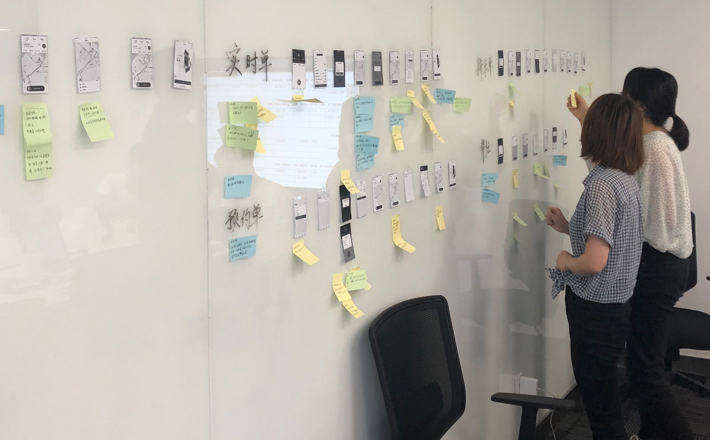
I invited product managers and engineers to the product audit, which can collect more perspectives from different roles. Meanwhile, they can get informed about this project in advance, and also provide their suggestions at the early stage.
2. Data Analysis​

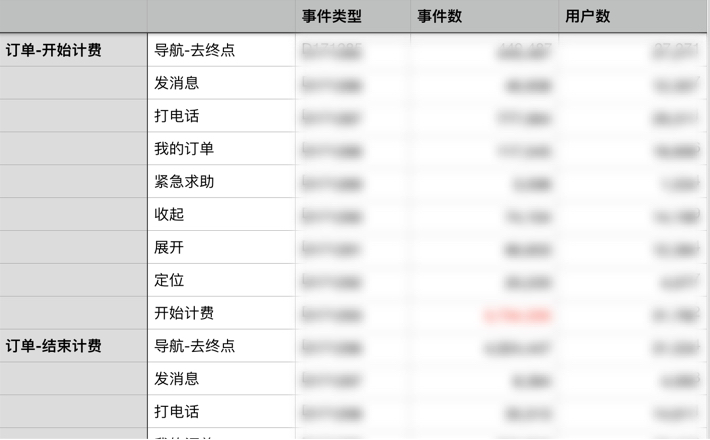
To comprehend the driver's working path and working habits, I partnered with data scientists to examine the data of the driver's primary scenarios, such as receiving trips, servicing riders, and navigating.
3. User Interview​

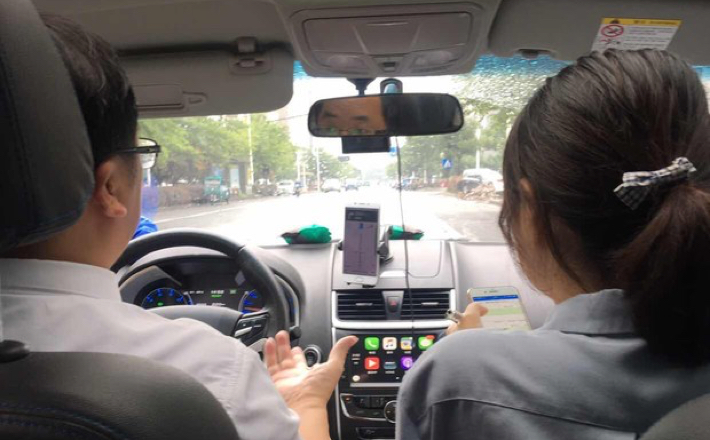
In this section, we interviewed 16 drivers. First, we identified key working scenario and then watched drivers work, like picking up orders. After shadowing, we interviewed drivers with some questions.
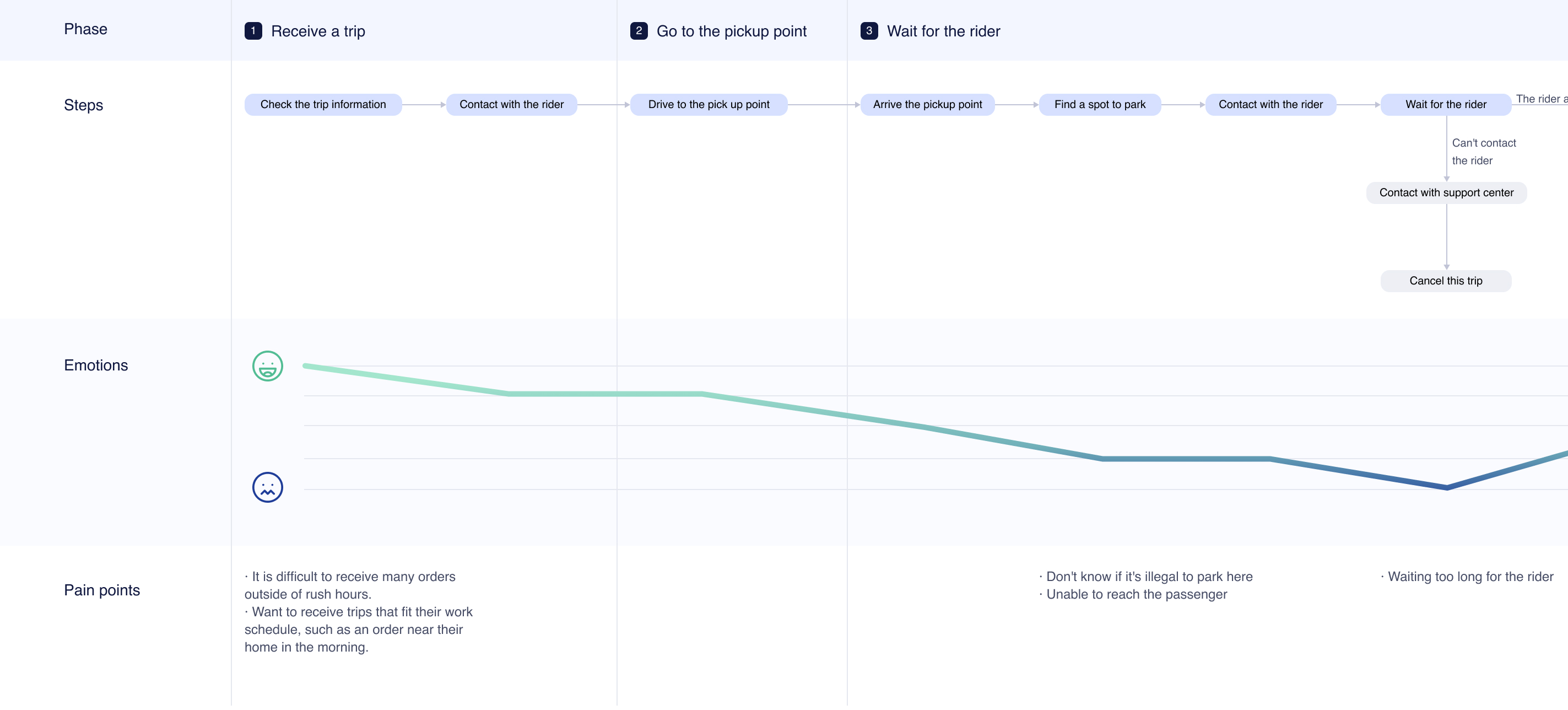
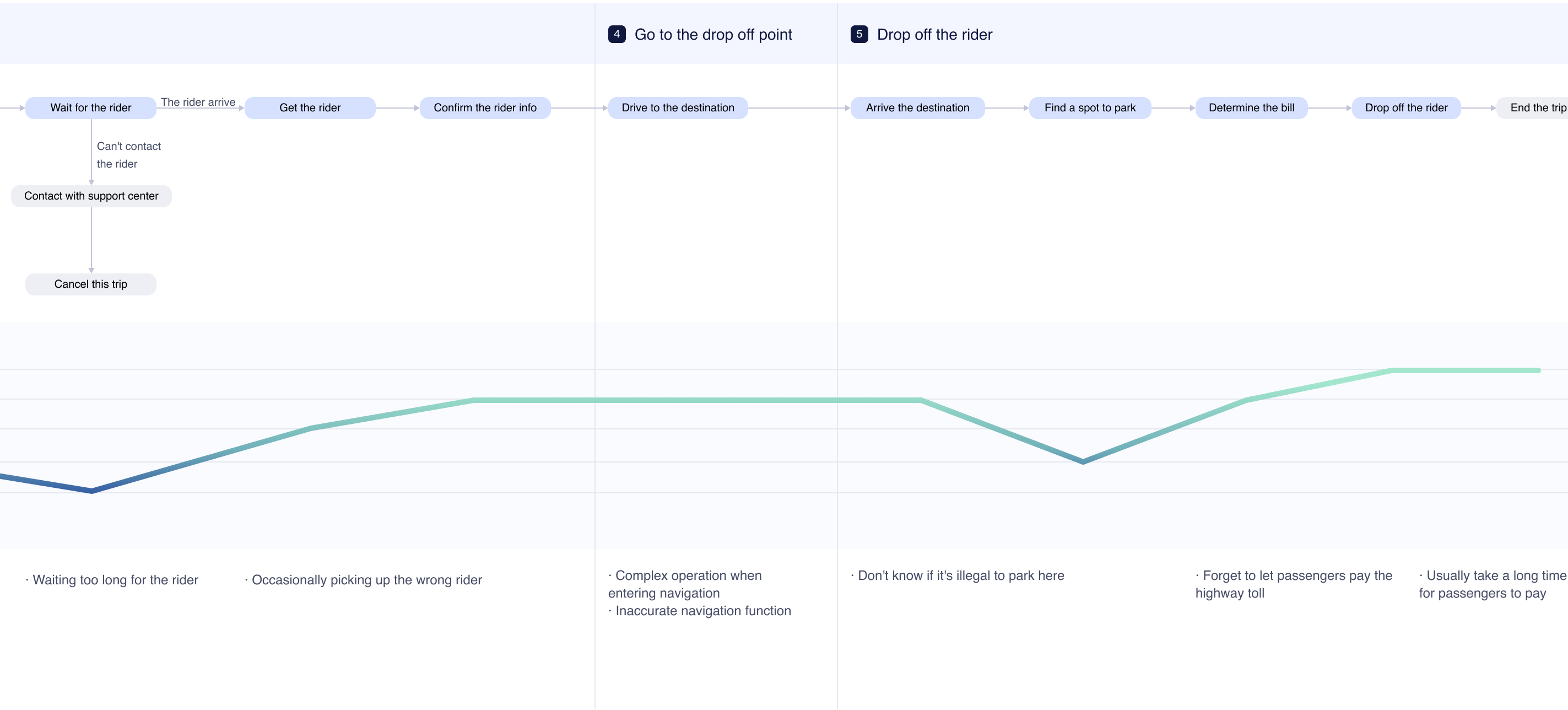
Current Driving Experience mapping​

In the aforementioned study, we gathered more than 70 user problems and discovered that the majority of the major issues arise during the pickup stage, such as contacting riders and locating the pick-up location.

Defining The Project's Scope​

We prioritized all the collected issues according to importance and urgency.  We solve problems step by step according to this priority.

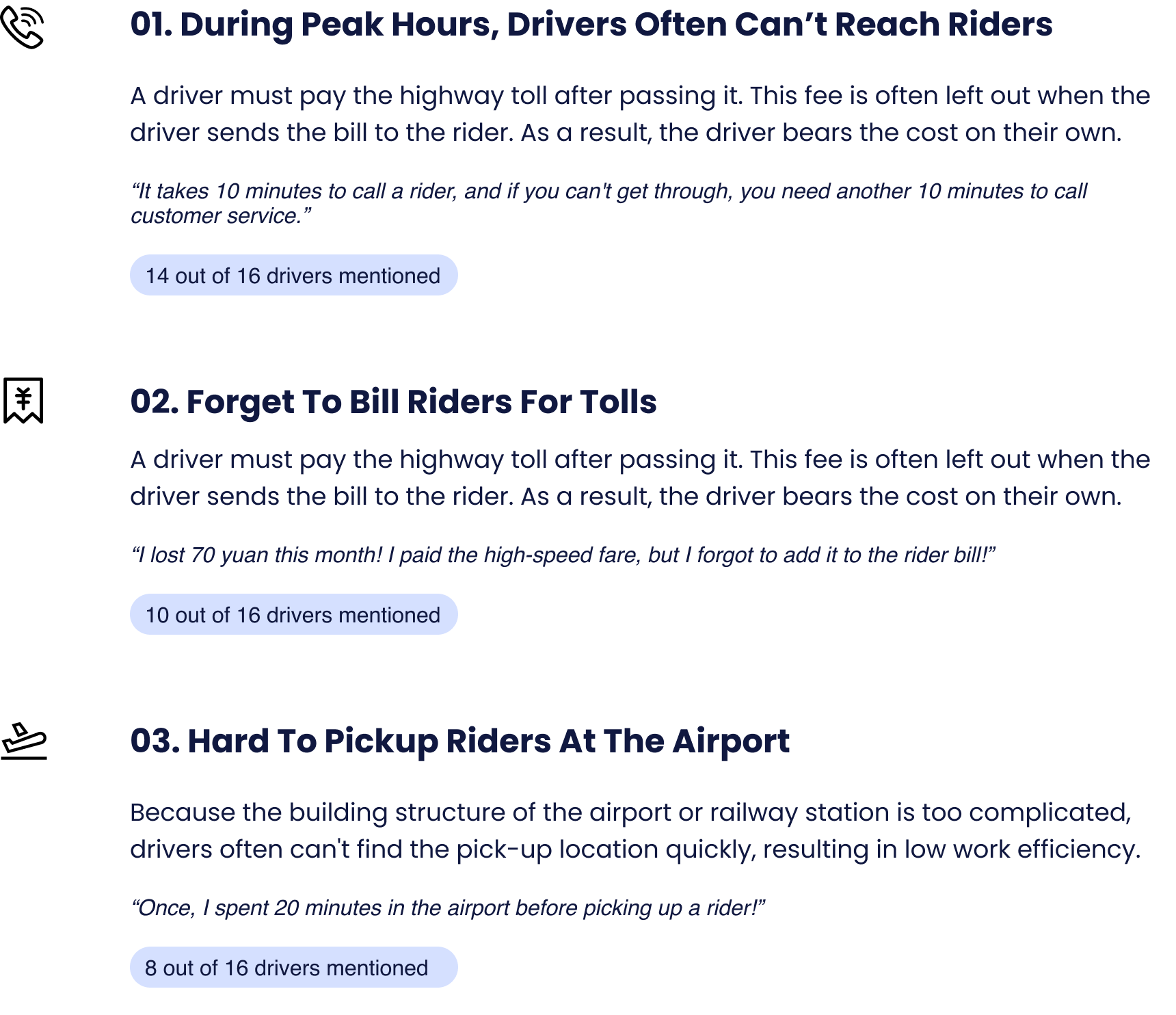
Here are the top three insights.

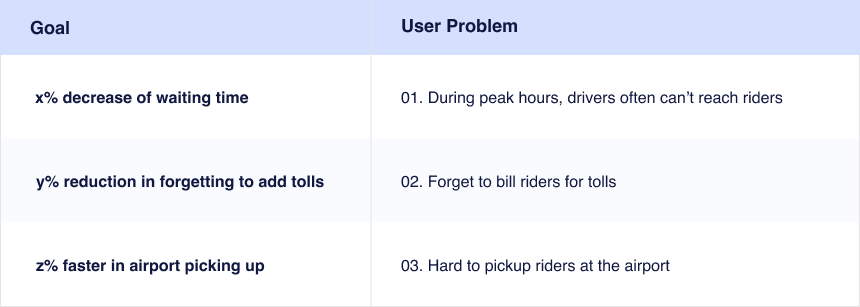
Define Success Metrics​

We launched the whole experience in multiple stages, and at each stage, we addressed a number of issues based on priority.

Before I began the design process, it was necessary to gain an understanding of the status quo and define success metrics. I partnered with our data analysis team to dig into the data.

Problem 1

Forget To Bill Riders For Tolls

The current system requires drivers to pay highway tolls in advance, which are often overlooked when billing riders. Consequently, drivers bear the cost themselves.

Considering the average duration of highway trips and the need for driver concentration, it is inevitable that drivers may forget to charge riders. Thus, the key design challenge is to reduce the memory burden on drivers .

Ideation

System Handles Tolls For Drivers​

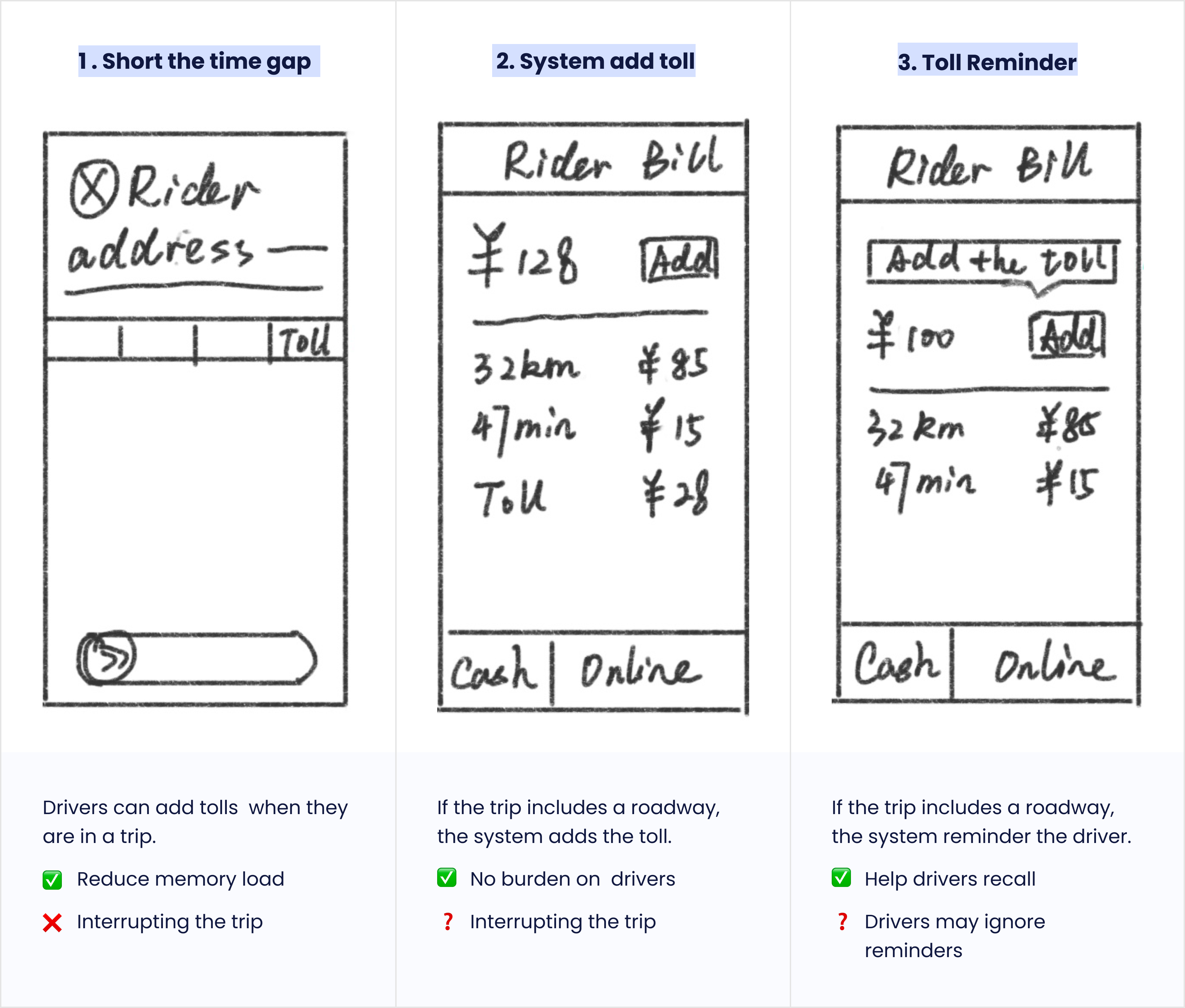
I looked at two main directions: one is to shorten the time gap, and the other is to have the system automatically bill riders for the driver.

I use sketches to discuss the pros and cons and feasibility of each option with product managers and engineers.

Design

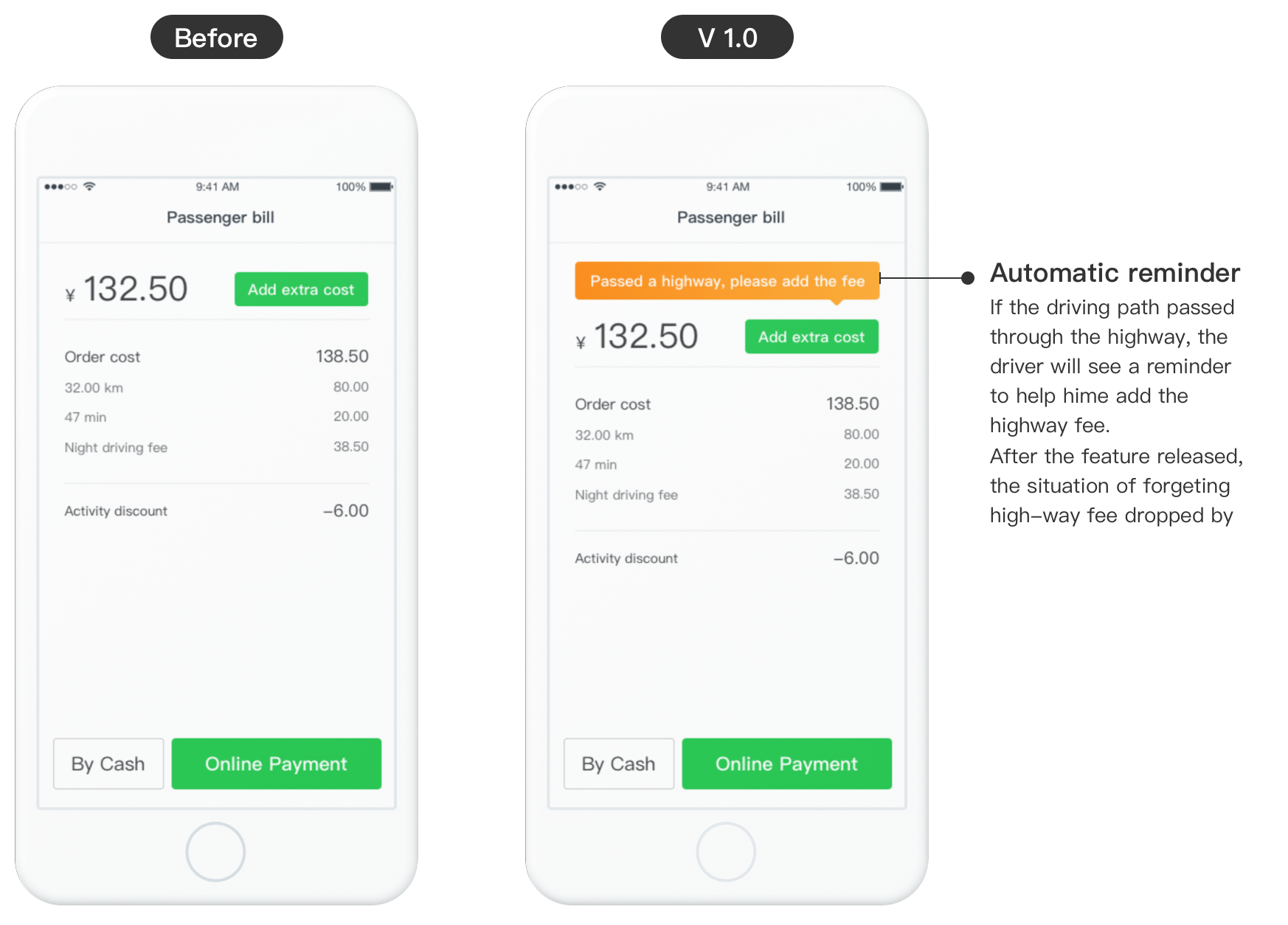
Automatically Remind Drivers To Bill Riders​

Upon consulting with engineers, I discovered that achieving a 100% accurate determination of whether a trip crosses a highway is technologically challenging. Consequently, I opted for Design 3, which entails reminding the driver to pay the toll if the predicted driving path indicates a highway crossing.

Impact

V1.0

Toll Omission Decreased by

11%

Iteration - Get More Users' Attention​

11% did not meet my expectation, so I started further user research. Using the backend data, I found 10 drivers to interview who had received a toll reminder but had not added it. 8 out of 10 interviewees mentioned:

“I didn't see a toll notice.”

Mr. Li

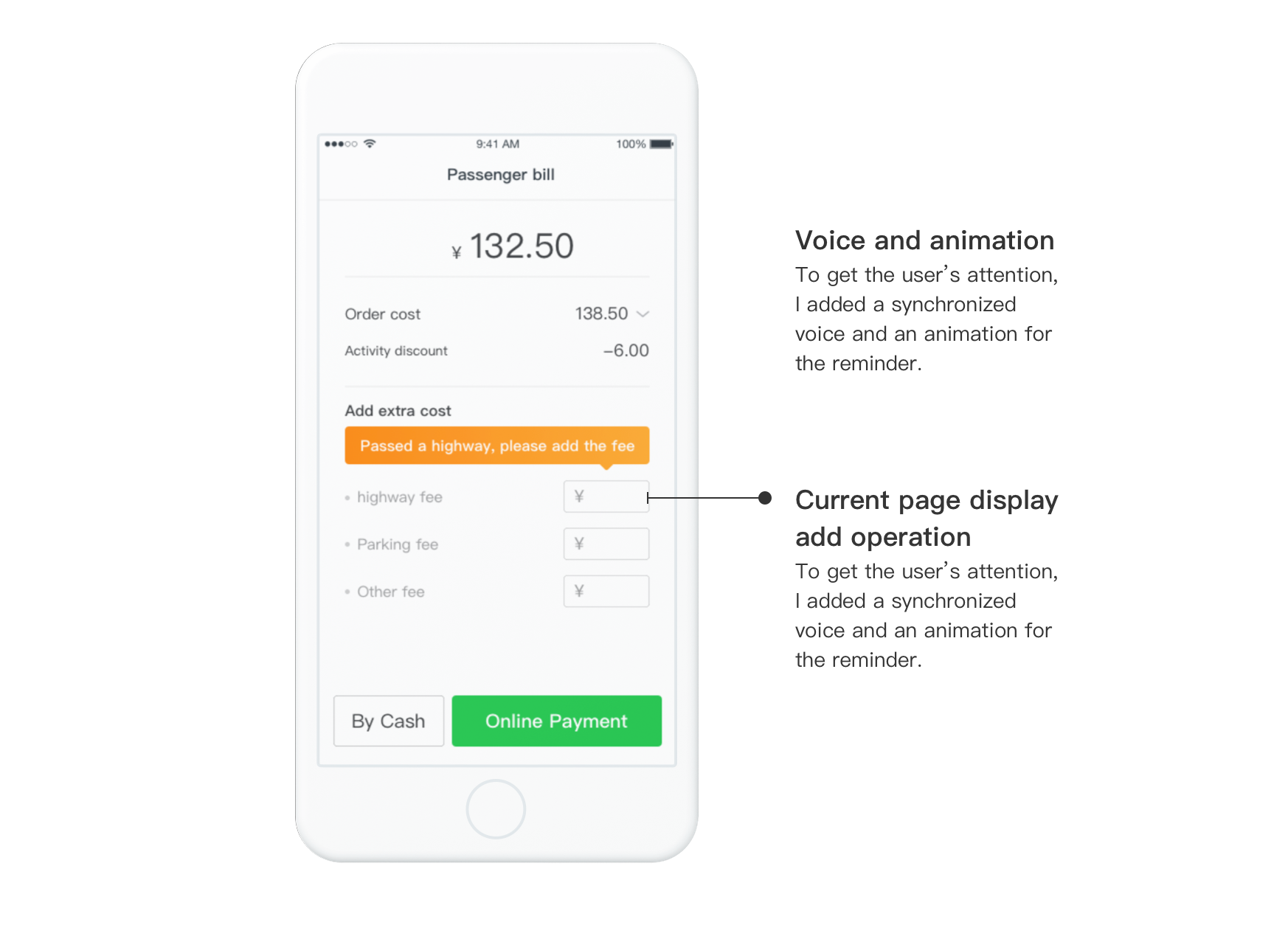
Further research revealed that while the system reminder was timely, drivers routinely ended trips on the passenger bill page by clicking the "Online Payment" button, failing to notice our recently added toll reminder function. To get the user’s attention, I added a synchronized voice and an animation for the reminder.

Impact

V2.0

Toll Omission Decreased by

47%

Problem 2

Hard To Pickup Riders At The Airport

Complex environments such as airports or railway stations can hinder driver efficiency due to the need for frequent communication and collaboration with riders. However, riders may lack precise pickup information or be unable to guide the driver effectively.

So my design direction is to reduce drivers and riders coordinate efforts.

Current limitations

Before jumping into design, I learned from product managers and operations colleagues that there are current limitations:

  1. How to promote the efficiency of hiring manager to manage workers
  2. What kind of data will affect hiring manager's performance

Constraints acknowledged, I chose the MVP method to design a simple yet effective solution. Data and feedback collection will determine its success and potential for further design iterations.

Ideation​

What Must Drivers Know To Pick Up Riders?​

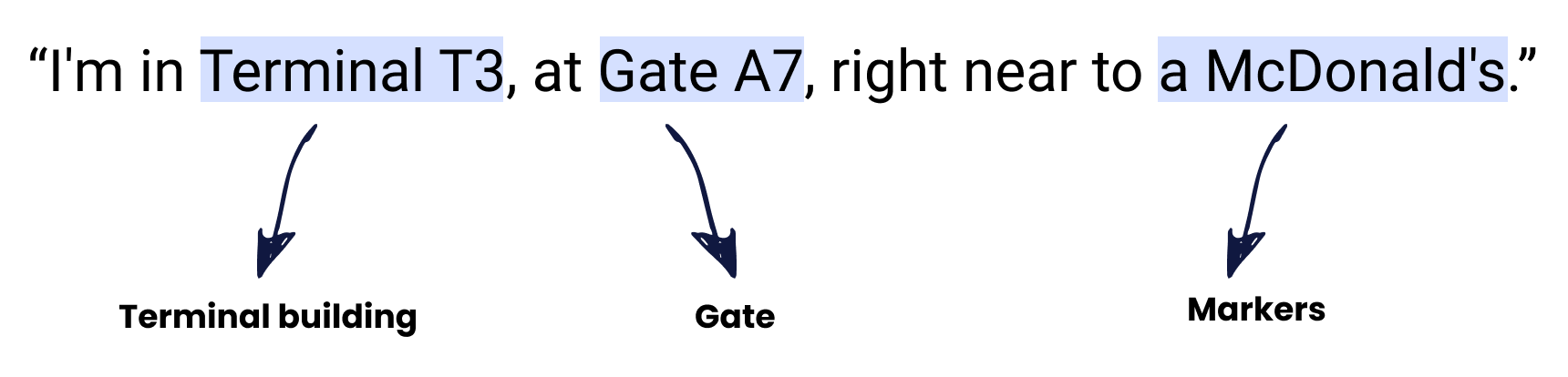
There is much location-related information in the airport, such as terminals, floors, departure gates, parking lots, etc., but only some of it is useful to drivers. I analyzed the content of driver-rider conversations when picking up riders, and I found that statements that help drivers get passengers quickly usually look like this.

Recommending Pickup Points​

To streamline the pickup process and minimize communication efforts, our platform should prioritize promoting convenient pickup points for both drivers and riders.

However, due to resource limitations, implementing a system recommendation feature was not feasible at this time. We opted to let drivers to direct the riders, and the driver speaks with the riders before the trip begins, after learning the airport and pick-up location.

Design

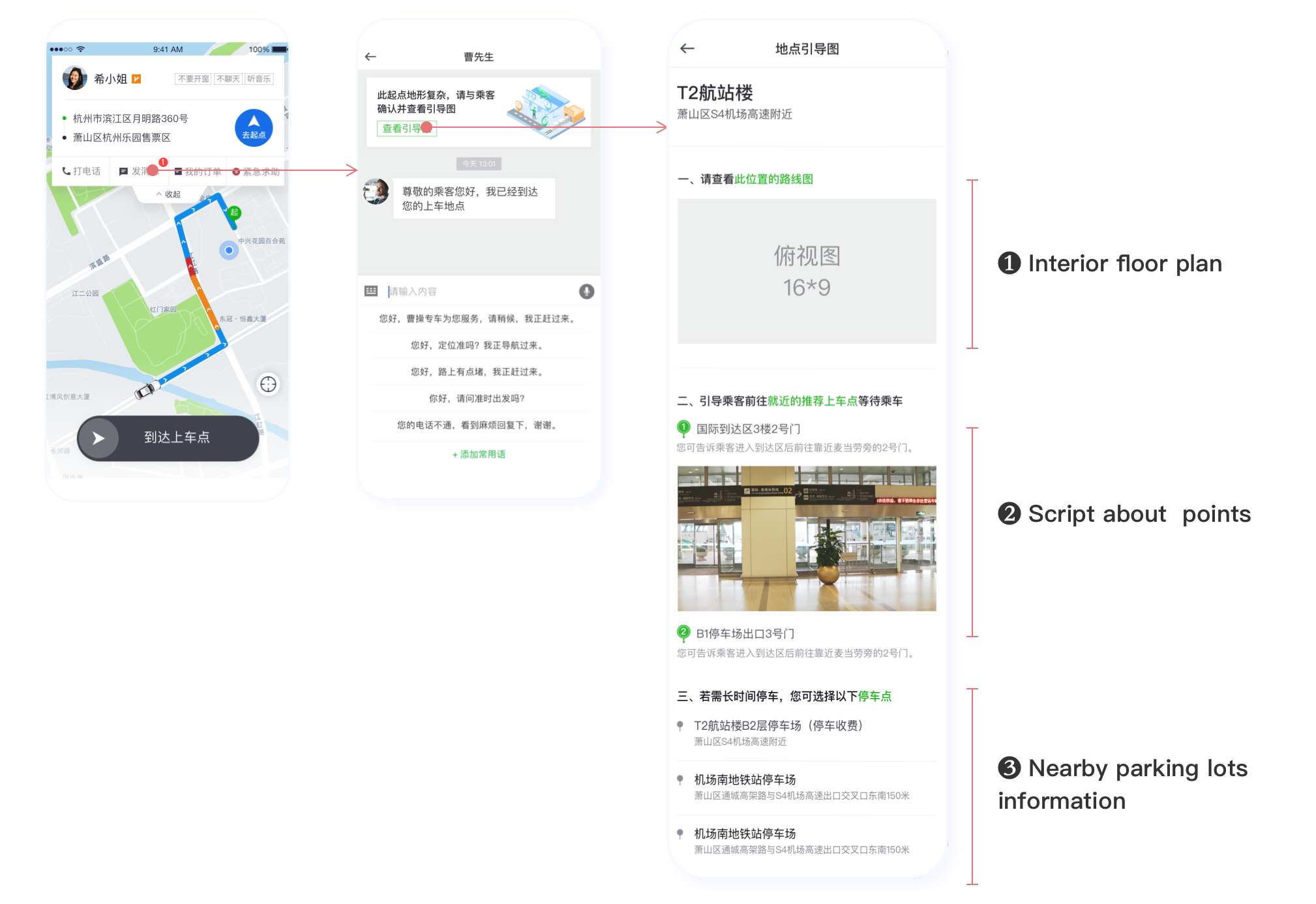
The driver will receive an airport guidance message after receiving an airport order. Drivers can view the following information:

  1. Interior floor plan
  2. A script directing riders to a pickup location
  3. Nearby parking lot information

Impact

V1.0

Airport pickup efficiency improved by

20%

The positive user feedback garnered significant attention for the project, resulting in additional resources allocated for further iterations. Currently, we are actively developing better options to enhance the pickup experience.

Learnings

Minimum usable design ​

We can divide and prioritize the project into many small tasks based on the principle of minimum available design, which is a more efficient way of promoting design.

Engage different roles in pre-design​

Engaging engineers and product managers in pre-design work can help to gather stakeholder opinions and get everyone on the same page.